FAQs about applications in the hydrogen industry
Hydrogen (H2) is a central component in future energy and industrial systems. In our FAQs, we answer frequently asked questions about applications relating to Functional Safety and Industrial Security in the hydrogen industry and help you to better understand the challenges and potential applications.
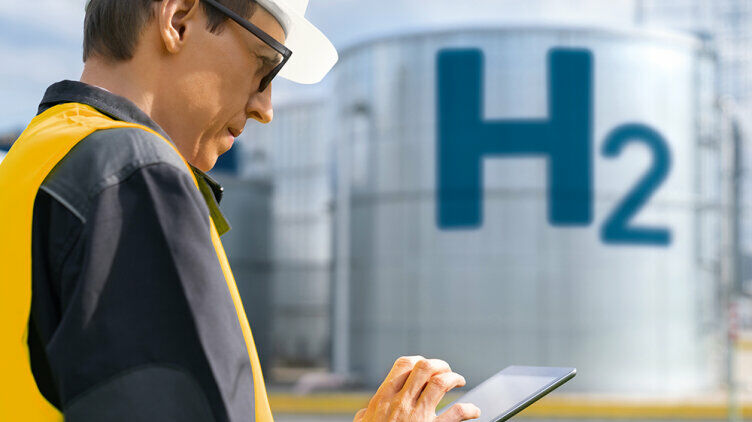
Risks and hazards when handling hydrogen
What are the risks of handling hydrogen?
Hydrogen is highly flammable, has a wide ignition range (4-78% by volume) and a very low ignition energy (40 μJ).
Leakages, fire, explosions and frostbite due to cryogenic hydrogen are key sources of danger.
Why is leakage detection so important on hydrogen systems?
Hydrogen diffuses through the tiniest cracks in the material and rises quickly in enclosed spaces. Leakages are difficult to detect and pose a considerable risk of fire and explosion.
How do you implement flame detection with hydrogen?
As hydrogen flames are almost invisible, UV/IR sensors or thermal gradient measurement are used. The latter enables reliable detection regardless of the fuel.
Legal framework and standards
What are the legal requirements for hydrogen technologies in the EU?
There are no specific hydrogen laws, but there are numerous guidelines such as:
- ATEX 2014/34/EU
- Pressure Equipment Directive 2014/68/EU
- Machinery Regulation 2023/1230 (applicable from 20/01/2027)
VDMA standard sheets are also pioneering.
Which standards apply to hydrogen refuelling stations?
ISO 19880-1, EN 17127 and SAE J2601 define safety requirements, refuelling protocols and interoperability for H₂ refuelling stations.
What does the ISO 22734 standard specify for electrolysers?
ISO 22734 describes safety requirements for hydrogen generators using water electrolysis – including test methods for components and materials.
Further information:
Functional safety in hydrogen plants
What does functional safety mean in the hydrogen industry?
Functional safety describes the reliable effect of safety-related control systems – from risk analysis and validation through to commissioning and maintenance.
Which standards regulate functional safety?
Important standards are EN ISO 13849, EN IEC 62061, EN IEC 61508 and EN IEC 61511. They define requirements for safety functions, safety integrity levels (SIL/PL) and lifecycle considerations.
How does safe pressure monitoring work?
Pressure transmitters and controllers such as PNOZmulti 2 or PSS 4000 record process values, compare them with limit values and trigger safety-related reactions in the event of discrepancies.
What needs to be considered with safe temperature monitoring?
Temperature monitoring is essential for refuelling in accordance with SAE J2601, for example. Failsafe analogue inputs and certified software modules guarantee compliance with safe temperature ranges.
Industrial Security and manipulation protection
What is meant by Industrial Security in the hydrogen industry?
Industrial Security protects automation and control systems from unauthorised access and manipulation. It is an integral part of functional safety
Which measures increase IT/OT safety?
Various measures prevent unauthorised access to safety-related systems:
- Identification and Access Management (I.A.M.) with authentication systems for users
- Entry and access management
- Data and network security measures
- Safe remote maintenance
- Segmented networks
How do you protect systems against operating errors and foreseeable misuse?
RFID-based identification, sequence-controlled operator guidance and safe control ensure that only authorised persons carry out safety-compliant processes.
Safety functions in hydrogen applications
Which safety functions are required for electrolysers?
Voltage and current monitoring, gas and flame detection and emergency stop are essential to prevent the formation of oxyhydrogen gas and electrical hazards.
How is safety guaranteed during steam reforming?
The standard ISO 16110-1 defines requirements such as EMC protection, pressure monitoring and explosion prevention. Burner management systems safely control the process heat.
What must be considered for hydrogen refuelling stations?
Safety functions include pressure and temperature monitoring, leakage detection, flame detection and emergency stop. Refuelling is carried out in accordance with SAE J2601 under defined conditions.
Which requirements apply to fuel cells?
IEC 62282-3-100 regulates the safety of stationary fuel cell systems – including pressure equipment, exhaust gas routing and electrical safety.
How do you guarantee the safety of hydrogen internal combustion engines?
Through safe monitoring of the mix ratio, leakage detection and limitation of the hydrogen content to max. 40 % for example.
Further information
Pilz Industrial Automation (Shanghai) Co., Ltd.
Rm 1702-1705, Yongda International Tower, No. 2277 Long Yang Road
Shanghai 201204
China
Telephone: +86 21 60880878
E-Mail: sales@pilz.com.cn
Telephone: 400-088-3566
E-Mail: sales@pilz.com.cn
